Package indexes
Use private package indexes, such as a company registry or a mirror, with their credentials kept in your OS keychain.
Define an index
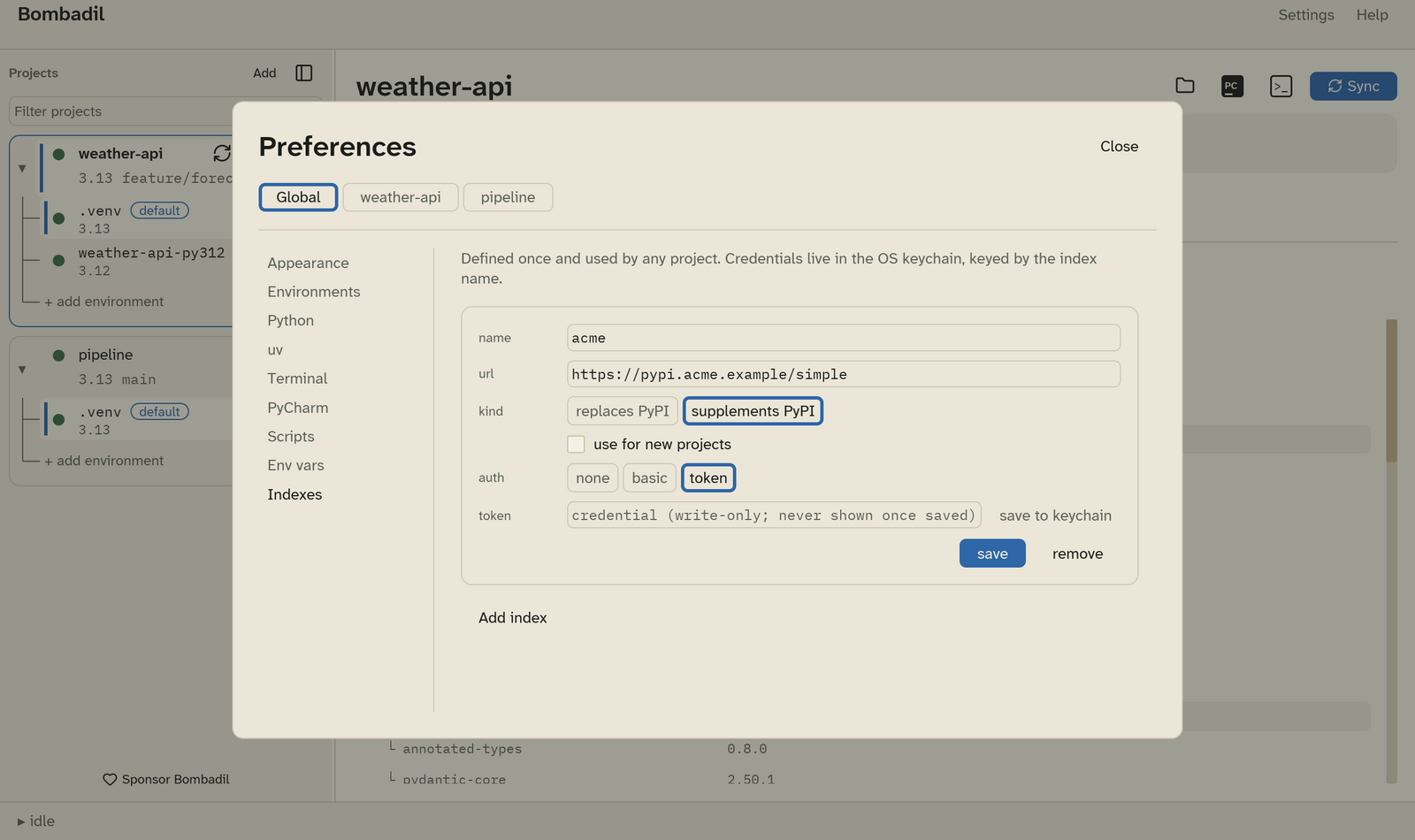
Indexes are defined once, globally, in Settings › Indexes. Click Add index and fill in:
| Field | Meaning |
|---|---|
| name | Letters, digits, - and _. uv uses it in the credential variable names, for example UV_INDEX_ACME_USERNAME. |
| url | The index's simple-API URL, for example https://pypi.acme.example/simple. |
| kind | replaces PyPI (the default index) or supplements PyPI (an extra index). |
| use for new projects | Select this index automatically for projects added from now on. |
| auth | none, basic (a username and a password) or token. A token is sent as the password with the username __token__. |
Type the password or token in the credential field and click save to keychain. The field is write-only: a saved credential is never shown again.
Use an index in a project
In a project's Indexes tab, tick the indexes it should use.
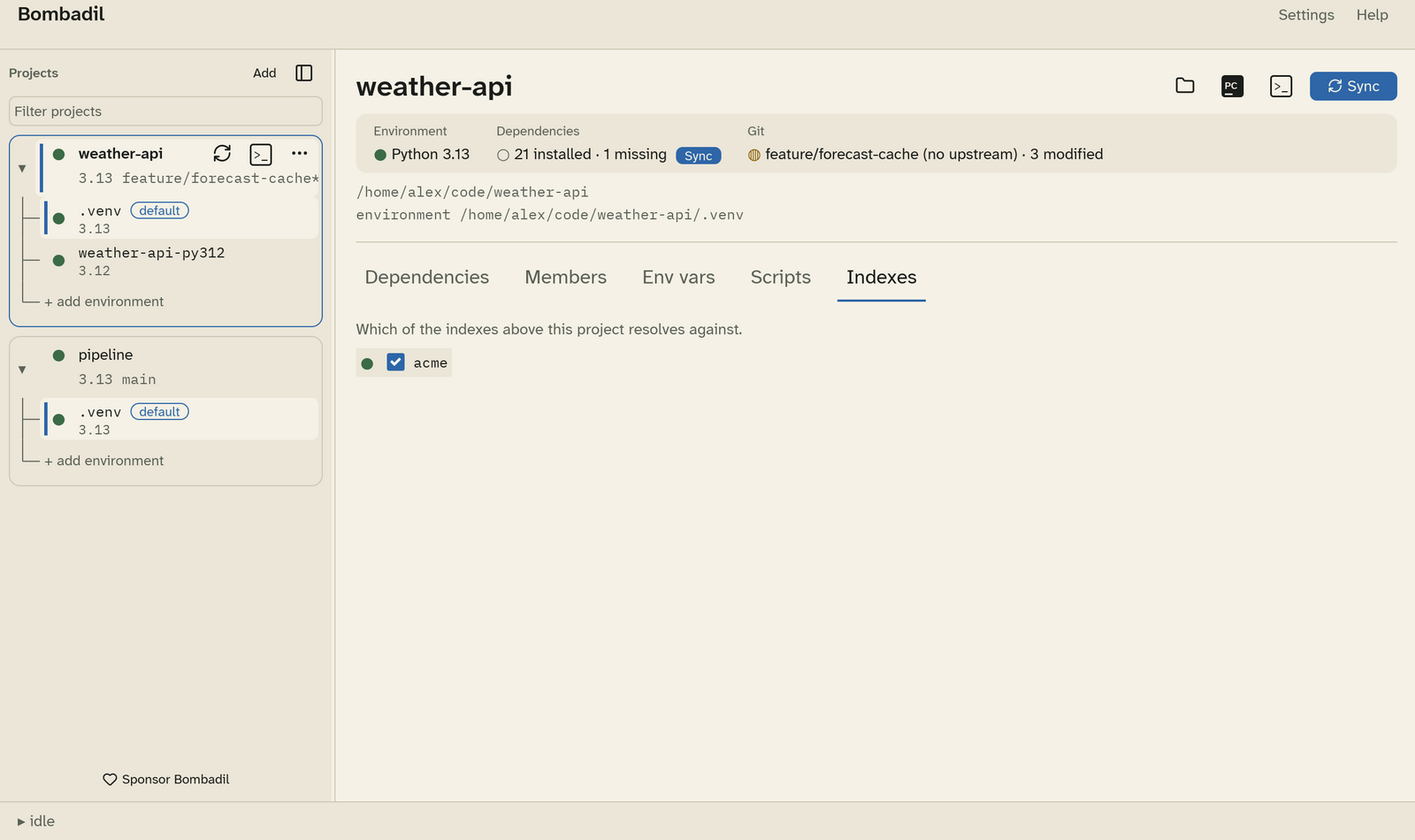
When it runs uv, Bombadil passes the selected indexes as UV_INDEX or
UV_DEFAULT_INDEX, plus UV_INDEX_<NAME>_USERNAME and
UV_INDEX_<NAME>_PASSWORD. The same variables reach your terminals and
PyCharm, so uv commands you run there also authenticate.
Only one index can replace PyPI
uv accepts a single default index. If a project selects two indexes set to replaces PyPI, the last one wins.
Names that collide
uv uppercases index names and turns - into _, so my-index and
my_index map to the same credential variables. Bombadil refuses to send
credentials when two selected indexes collide like this.